Stay in touch
Subscribe to our mailing list for all the latest news and developments about Natural Capital Suite.

Truii acknowledges the Traditional Owners of Country throughout Australia. We pay our respects to Elders past, present and emerging.


An Action is a Natural Resource Management Activity, and is the combination of both:
It is important to consider an Action as both the on-ground change and the support associated with the change because the support has a large impact on the cost to implement an Action and also the likelihood of adoption of the Action.
For each Natural Capital Region region there are libraries of Actions. Some Actions may be common across regions, but their cost or effectiveness at improving environmental conditions may be regionally specific.
There is at least one ‘master’ library of Actions for each region. Master libraries are curated by Truii and cannot be edited by users. However, users can create their own libraries of Actions which are editable.
To track how much of an Action may be applied, all Actions have a ‘starting land type’ (e.g. forested grazing). Actions can also have an end land type. The end land type allows the creation of Actions that transform land use (e.g. forested grazing to conservation).
When running a scenario, Natural Capital Region applies a portfolio of Actions. When the Action is applied, the effect of the action across the 17 indicators is calculated over a period of 15 years to allow the differentiation between fast-acting and slow-acting Actions.
Negative Actions are used to represent business as usual to account for a continuously declining baseline condition due to ongoing degrading practices. These Actions are applied at the specified area for each year of the 15-year implementation period. For example a tree clearing Action set at current Qld clearing rates of ~1% of available area will be applied to 1% of the available Category X (unprotected) vegetation in the planning unit each year for 15 years of the Scenario.
| Negative Action type | Example Action | Applies to these land types (determines how much of the Action could be conducted) |
|---|---|---|
| Vegetation clearing | Continue to clear vegetation at the current rate | Vegetation that may be cleared (unprotected category X vegetation) |
| Point Source | Continue to increase the nitrogen from the wastewater treatment plant at the rate of town growth (3% per year) | none – point source is not dependent on available area |
Positive Actions are those which are considered in generating a Natural Resource Management investment portfolio. Positive Actions are different from negative Actions in that they have a cost and they have an adoption likelihood. There are seven types of positive Action. The Action types are based on the grouping of starting land types. Each positive Action type has a limited range of starting land types that could be applied for the Action. For example, preservation Actions can only be applied to areas of known vegetation.
| Positive Action type | Example Action | Applies to these land types (determines how much of the Action could be conducted) |
|---|---|---|
| Broadacre practice change | Reduced stocking rates / cell grazing to increase cover | Cropping Grazing Conservation Forestry Urban Rural Residential |
| Preservation | Preserve high quality vegetation using a covenant | Terrestrial areas with woody vegetation Vegetated riparian areas Vegetated areas of wetland-swamps (palustrine) Vegetation that may be cleared (unprotected category X vegetation) |
| Revegetation and restoration | Revegetate large areas of grazing lands as part of a carbon farming initiative | Unvegetated riparian areas Unvegetated areas of wetland-swamps (palustrine) Terrestrial areas with woody vegetation |
| Gully Management | Reprofile gully, fence and revegetate | Gully |
| Intensive Agriculture Remediation | Add a drainage pond to capture all site runoff from Cattle feedlot | Feedlots Piggeries |
| Point Source | Conduct a major upgrade at a water treatment plant | none – point source is not dependent on available area |
| Other | Conduct community education campaign on the value of biodiversity | all above |
There are a large number of properties that can be configured for an Action. Actions exist in libraries. To speed up future Action set up, Action libraries can be copied, as can individual Actions.
Metadata such as Action name, description, supporting information and associated attachments or links can be captured for each action. This is how the rationale, supporting science, revision notes or other documentation about an action is captured.

There are two cost fields (initial cost and annual ongoing cost). The cost fields are very important in determining the priority order of investment because the priority is based on cost effectiveness. The costs in the master libraries curated by Truii reflect the cost to an NRM investment agency (e.g. federal government) to get work done. These costs will typically include a project management overhead of ~20% over and above the cost of on-ground implementation. The ongoing costs are typically set as a percentage of the initial costs depending on the project type (typically 1% – 3%).
The ongoing costs are applied for a 15-year period from the project commencement.
We don’t always have an accurate cost estimate for an Action. The cost confidence across all actions in a scenario is presented in the scenario results to provide a range in project budget estimates.
No indexing or inflation is applied to the project costs.

There are six ways to capture the effect of an Action on an Indicator. Available Action effectiveness settings vary depending on the indicator.
1. Efficacy: proportional change in the indicator (-1 to 1)
e.g. Riparian fencing revegetation with an ongoing maintenance program has a stream bank efficacy of 0.3. That is, the streambank fine sediment load generated by the section of stream which is being treated will reduce by 30%.
2. Yield: change in load per unit area
e.g. Implementing controlled traffic in dryland cropping has been modelled to reduce sediment yield on average by 1.84 t/ha/a. That is, irrespective of the initial load of fine sediment being generated from this land type, we estimate a fixed reduction of 1.84t for every hectare that this Action is Applied.
3. Fixed load
e.g. Implementing a wastewater treatment plant upgrade is estimated to reduce the dissolved inorganic nitrogen load to a stream of 100t/a. That is, the overall nitrogen load should be reduced by 100t (there is no area scaling)
4. Log reduction: applies for microbial load. This is a yield value expressed in the log domain
e.g. Creating effluent ponds to capture runoff from a cattle feedlot will result in a 3-log reduction in bacterial load from the facility.
5. Biodiversity value relative to remnant vegetation
e.g. A mixed planting revegetation Action uses locally sourced endemic species planted at naturally occurring densities and has a robust weed maintenance program. The end point biodiversity value of this Action relative to remnant vegetation is 1.
6. Likert scale
e.g. Where the science is less well known, the effectiveness is captured as an efficacy via a 7-point scale system (commonly called a Likert scale) from significantly negative impact to significantly positive impact.
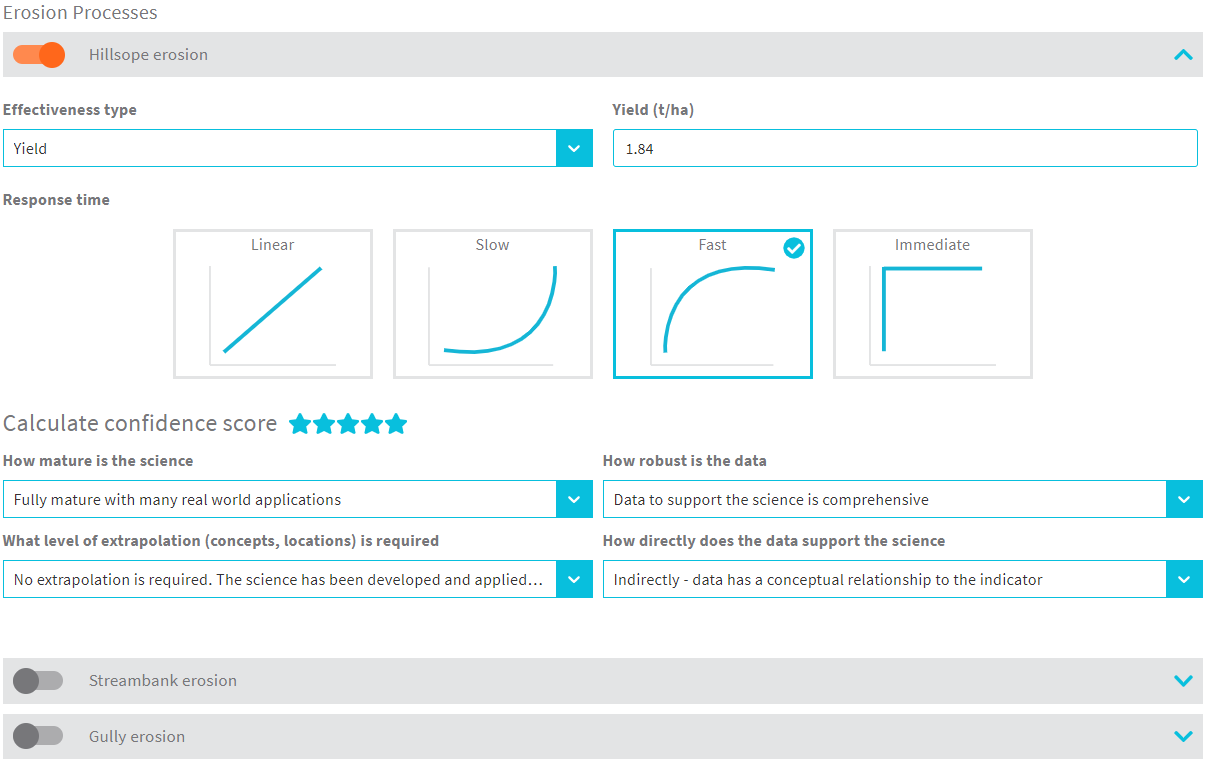
Many NRM activities are tried and true, with a long history of successful implementation. However, some are new and unproven. The effectiveness confidence qualifies the level of confidence that we have in the predicted outcome, and presents this in the results view.
The confidence in the estimated effectiveness of an Action on an indicator is captured via a four-question survey. The survey covers data uncertainty and epistemic uncertainty. Epistemic uncertainty is uncertainty in our understanding of the system (unknown unknowns). The measure of epistemic uncertainty is based on the maturity of the science that supports the effectiveness estimation (more mature science is assumed to have lower epistemic uncertainty)
Natural Capital Region uses the CSIRO ADOPT computational approach to estimate the peak level of adoption and time to achieve that peak adoption level. The method is based on a survey about the landholder/industry and their motivations, the Action and the combined context of the Action applied to the industry.

Subscribe to our mailing list for all the latest news and developments about Natural Capital Suite.
Truii acknowledges the Traditional Owners of Country throughout Australia. We pay our respects to Elders past, present and emerging.


